
Sell Old Tools Individually or as a Lot? How Appraised Value Guides the Decision
Deciding whether to sell tools individually or as a lot depends on which pieces carry real collector value. This guide shows how an appraisal separates rare wrenches from ordinary mixed lots, with a decision table and a sorting process.
Published · Updated
Key Takeaways on Selling Old Tools Individually or as a Lot
Here is what owners and executors need to know before deciding to sell tools individually or as a lot:
- Default rule: Ordinary mixed hand tools and wrenches sell best as a lot, because buyers bid on quantity and utility rather than on any single piece.
- Exception: Rare, maker-marked, patented, or complete pieces sell best individually, because collectors want to inspect the maker mark, the patent dating, and the completeness of each tool.
- Worked example: One HiBid auction lot of 17 rusted, pitted hand tools and wrenches carried an estimated retail value of $25 to $45 and realized $2.00.
- Role of appraisal: A tool appraisal identifies which pieces in a collection deserve to be pulled out before the rest goes into a lot.
- Fair market value: The IRS defines fair market value as the price a willing buyer and a willing seller agree on, and that figure supports estate, donation, and insurance uses beyond the sale.
Selling old tools individually or as a lot is a valuation question before it is a listing question. A box of mixed wrenches and a single maker-marked wrench can sit side by side in the same garage and belong in two different sales. This guide covers how appraised value separates the two, how to sort a collection, and what to watch out for before the auction closes. Readers who want a quick read on specific pieces can start with our guide to which old wrenches are worth money.
What Does an Unsorted Mixed Tool Lot Actually Sell For?
An unsorted mixed tool lot can sell for a small fraction of its estimated value. One HiBid auction lot from LL Auctions in Bacliff, Texas, shows the pattern. The lot held 17 assorted vintage and modern hand tools and wrenches, including Klein Tools, Thorsen, and Crestalloy pieces and an adjustable wrench, all with visible rust, heavy pitting, and wear.
The lot carried an estimated retail value of $25 to $45. The price realized was $2.00, and the auction added a 15% online buyer's premium, which is $0.30 on top of the hammer price for the buyer.
Example: A lot estimated at $25 to $45 that realizes $2.00 returns about 4% to 8% of the estimate before any seller-side costs.
That result is one example, not a rule for every mixed lot. The lesson is narrower: a lot priced by quantity gives the seller almost no credit for any single standout piece inside it.
General auction guidance supports lotting for everyday goods. One auction guide on bulk item sales gives $10 to $25 box lots as an example for ordinary tools, while recommending individual lots for items with stronger standalone demand. That is an auction-format example, not a universal price schedule.
How Appraised Value Decides Whether to Sell Tools Individually or as a Lot
Appraised value decides the lot question because it measures what each tool is worth to a willing buyer, not what the tool cost new. The IRS states in Publication 561 that fair market value is the price at which property changes hands between a willing buyer and a willing seller, neither compelled to act, with both having reasonable knowledge of the relevant facts. Used household items generally sell for far less than their original cost, so original retail prices are not a guide.
An appraisal of old tools weighs the following value factors:
- Maker marks and rarity: A scarce maker or a discontinued model draws collector demand that a common brand does not.
- Condition and originality: Original finish, intact markings, and absence of heavy pitting or damage support higher values than rust, pitting, and repairs.
- Patent features: Patent dating and distinctive mechanisms identify early or unusual wrench designs that collectors seek.
- Completeness: A full socket set, a matched set of wrenches, or a tool with its original case outsells loose, mismatched pieces.
- Comparable sales: Completed sales of the same make and model in similar condition outweigh asking prices on current listings.
A practical appraisal separates three figures for a collection. The first is individual-sale value, the expected proceeds if each tool sells separately. The second is lot value, the expected proceeds from one buyer taking the group. The third is net value, the proceeds after commissions, buyer's premium effects, shipping, and the labor of handling many small transactions.
Individual listing wins only when the extra gross revenue exceeds the extra cost and effort. Our appraisers at Millwright Equipment Appraisers research and describe each piece and value it on market evidence. They do not authenticate or grade tools.
Decision Table: Individual Listing or Lot for Old Tools
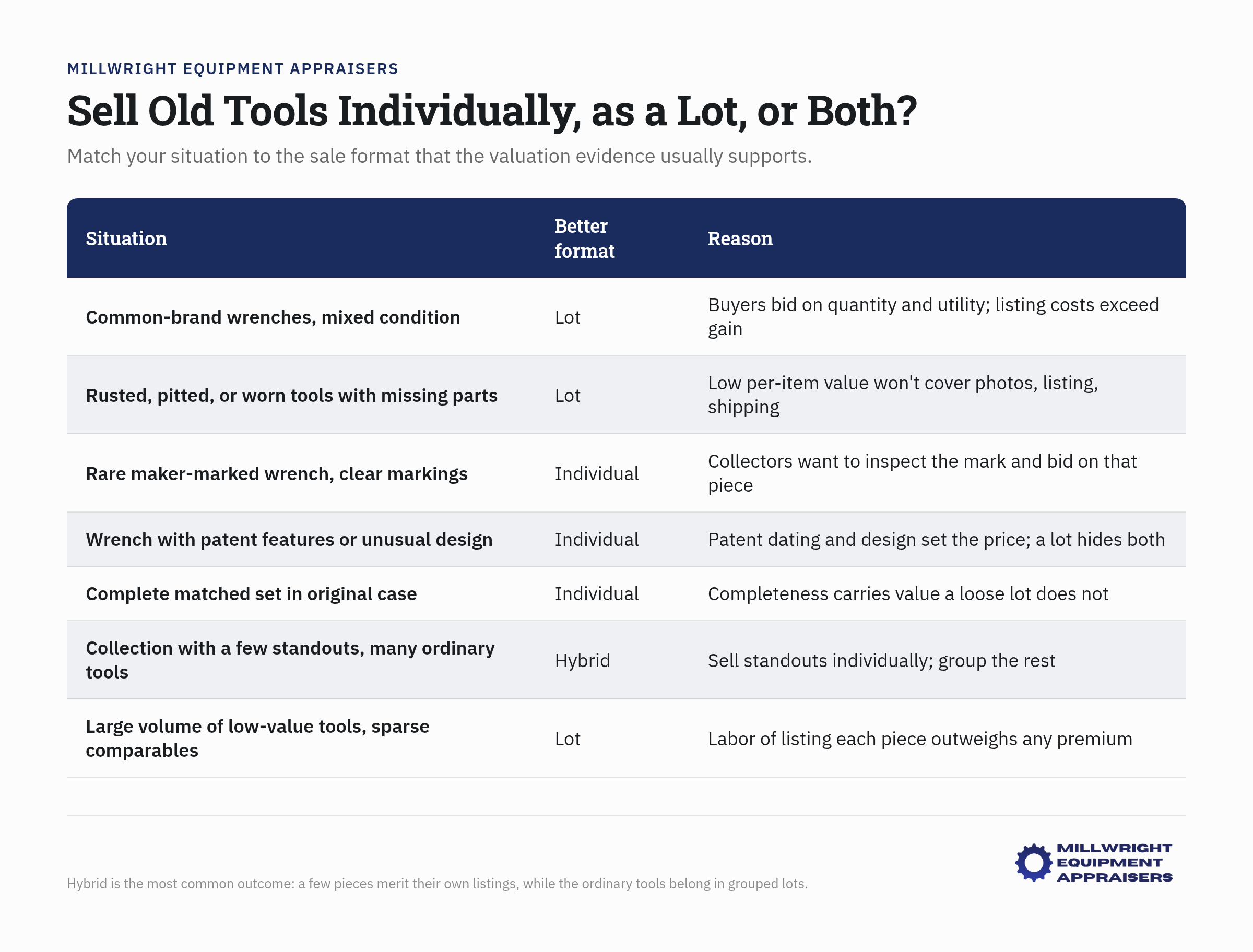
The table below matches common situations to the sale format that the valuation evidence usually supports.
| Situation | Better format | Reason |
|---|---|---|
| Common-brand wrenches and hand tools in mixed condition | Lot | Buyers bid on quantity and utility, and individual listing costs exceed the gain |
| Rusted, pitted, or worn tools with missing parts | Lot | Low per-item value does not cover photography, listing, and shipping |
| Rare maker-marked wrench with clear markings | Individual | Collectors want to inspect the mark and bid on that piece alone |
| Wrench with patent features or an unusual design | Individual | Patent dating and design set the price, and a lot hides both |
| Complete matched set in original case | Individual | Completeness carries value that a loose lot does not |
| Collection with a few standouts and many ordinary tools | Hybrid | Pull the standouts for individual sale and group the rest |
| Large volume of low-value tools with sparse comparable sales | Lot | Labor of listing each piece outweighs any premium |
The hybrid row describes the most common outcome. A mixed collection usually holds a handful of pieces that justify their own listings and a larger body of ordinary tools that belong in grouped lots.
Step-by-Step: Sorting Old Tools Before You Sell Individually or as a Lot
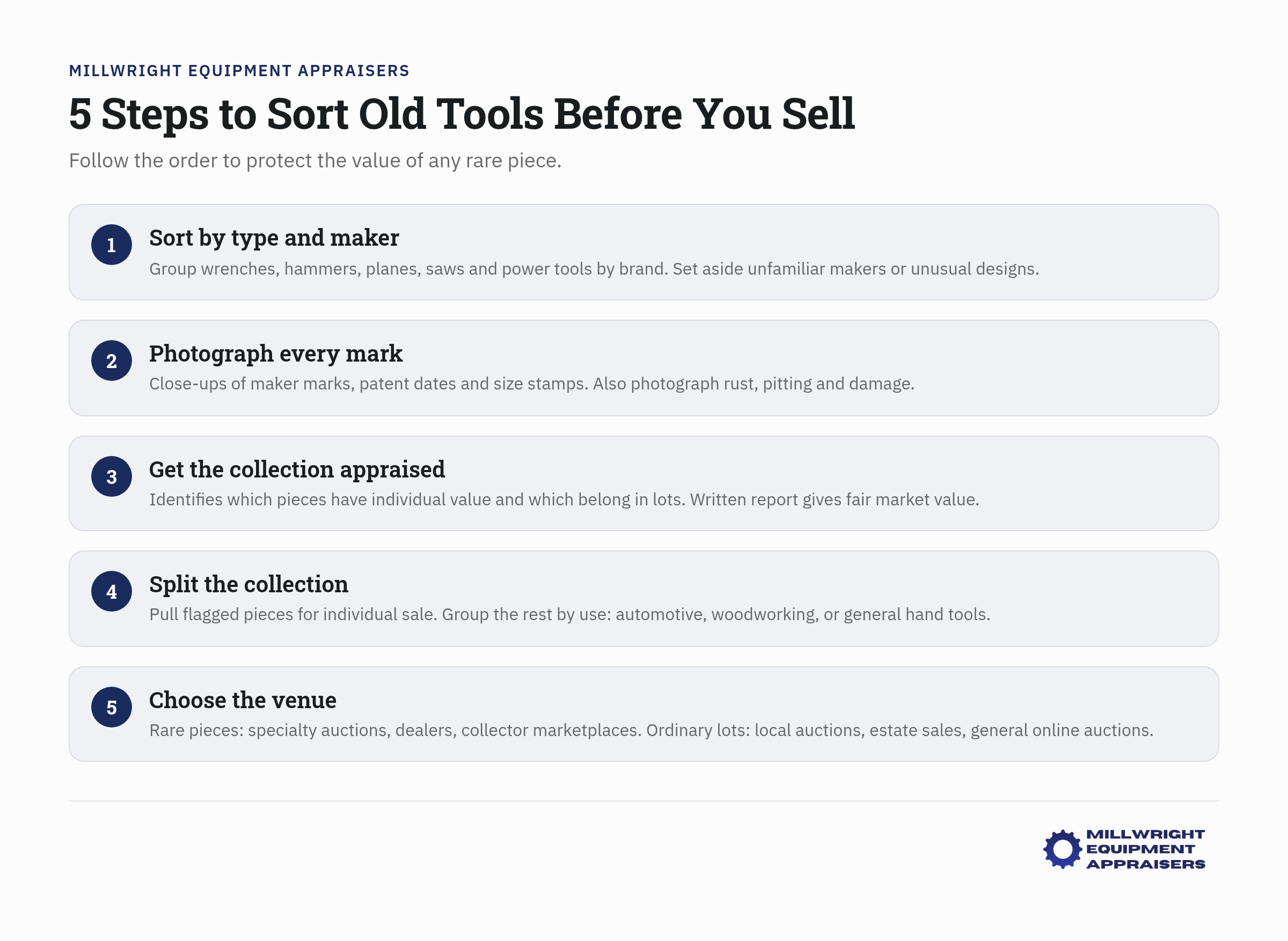
Sorting old tools before the sale follows a fixed sequence, and the order protects the value of any rare piece.
- Sort the Collection by Type and Maker
- Separate wrenches, hammers, planes, saws, and power tools, then group each type by brand.
- Set aside any piece with an unfamiliar maker or an unusual design.
- Photograph Every Mark
- Take clear close-ups of maker marks, patent dates, and size stamps on each wrench and tool.
- Photograph rust, pitting, and damage as well, so the condition record is honest.
- Get the Collection Appraised
- An appraisal of the group identifies which pieces carry individual value and which belong in lots.
- The written report documents fair market value for each flagged item.
- Split the Collection
- Pull the pieces the appraisal flags for individual sale.
- Group the remainder by use, such as automotive, woodworking, or general hand tools, so buyers can see what they are bidding on.
- Choose the Venue
- Match rare pieces to specialty auctions, dealers, or collector marketplaces.
- Send ordinary lots to local auctions, estate sales, or general online auctions.
Watch Out: Cleaning, Buyer's Premiums, and Seller Fees on Tool Lots
Watch out: Cleaning a rusted tool can destroy collector value. Collectors of antique wrenches often prefer original patina and intact markings, and wire brushing, grinding, or heavy polishing can erase the marks that identify a maker. Leave rust and surface wear alone until an appraiser has reviewed the piece.
Buyer's premiums change what bidders will pay. In the HiBid example, the 15% online buyer's premium meant a buyer's total cost exceeded the hammer price, so bidders discount their bids to account for it. Seller-side commissions, listing fees, payment fees, and shipping costs also reduce net proceeds, and each venue sets its own terms. Read the fee schedule for each venue before comparing offers.
Pro tip: Compare expected net proceeds under both strategies, not headline prices. A $60 individual sale that costs $25 in fees and shipping nets less than a $40 lot sale that costs $5.
Why a Tool Appraisal Matters Beyond the Sale
A tool appraisal supports more than the choice between a lot and an individual listing, because the same fair market value figure serves several other purposes. Executors need a defensible value for inherited shops and garages, and our tool appraisal for estate and probate work documents that value before heirs split or sell the contents.
Donors need a value as well. The IRS explains in Publication 547 that household items generally must be in good used condition or better for a deduction, and that a deduction above $500 for an item not in good used condition requires a qualified appraisal. A qualified appraisal is generally required for donated property claimed above $5,000. Similar donated items can be appraised as a group when the appraisal and Form 8283 carry the required information.
Millwright Equipment Appraisers prepares tool appraisals in accordance with USPAP, and our appraisers hold credentials with leading organizations such as the ISA, ASA, and AAA. Tool appraisals start at $295 for a standard report and $395 for an advanced, IRS-qualified report. Each engagement is quoted as a fixed fee before work begins, never billed hourly, and the final fee depends on the scope of the collection, the quality of the records, and the intended use.
Pull the Rare Pieces Before the Lot Goes Out
Ordinary mixed hand tools belong in lots, and rare, complete, or maker-marked pieces belong in individual listings. The only reliable way to tell them apart is to document each piece against completed sales of comparable tools. A short appraisal before the auction costs far less than a rare wrench disappearing into a $2.00 lot.
Owners and executors who are unsure which pieces to pull can request an appraisal from Millwright Equipment Appraisers and receive a written valuation of the collection before choosing a sale format.
This article is provided for general informational purposes only and does not constitute legal, tax, or financial advice. Readers should consult a qualified attorney or CPA regarding their specific circumstances.